


many organisations claim to be customer-centric, yet their internal operations tell a different story
Journey management pilots pop up across departments, each with good intentions — but without alignment or lasting impact. The result? Fragmented experiences, slow progress, and missed opportunities to truly improve customer journeys.
To move beyond isolated efforts and towards consistent value delivery, companies need more than enthusiasm. They need structure.
In this blog, we explore how organisations can build a scalable, governance-led approach to journey management. You’ll learn how to move from siloed pilots to a scalable approach that aligns teams, secures ownership, and drives measurable results.
the challenge with journey management pilots
Journey management pilots often result in insightful journey maps — but translating those insights into real change is another story. Many pilots struggle to prove impact, not because the ideas aren’t strong, but because implementation falls short. The key blockers are often limited decision-making power and lack of alignment with the goals of departments. That’s not to say we should stop doing pilots—we should, but with the right approach to scale journey management.
For successful journey management pilots, cross-functional collaboration is essential. This requires more than a motivated CX expert — it demands a team with the authority to experiment, make decisions, and drive improvements. This team will learn by doing what a scalable operational model for continuous improvements looks like for your organisation.
Essense has helped leading organisations make this shift. We’ve identified the key principles of journey management implementation and developed a phased approach. Keep reading if that’s what you’re looking for.
core principles for journey management implementations
Before diving into implementation, it’s crucial to understand what makes journey management succeed at scale — and where it often breaks down.
Collaboration between departments is non-negotiable
Journey management can’t live in a silo. Managing a journey requires alignment between departments who contribute to the delivery of this journey. Organisations should agree to dedicate resources from multiple departments for journey management.
Pilots without power don’t scale
Many journey teams operate with valuable insights but lack the authority to act on them. Without clear roles and responsibilities, even the best ideas stall. Ensuring that teams can not only identify but also implement improvements is essential. Product owners of relevant channels should be on board to secure implementation.
Governance must be designed, not assumed
Effective governance doesn’t happen by accident. It requires intentional design: defining roles, decision-making rituals, and ownership structures that empower teams and secure accountability across the organisation.
Start small, but start with structure
A successful transformation starts with a dedicated team, leadership sponsorship, and clear milestones. Starting small allows learning fast — but doing so within a structured change plan paves the way to successful experimentation.
Take the organisation along for the ride
Throughout the process, it’s vital to keep the broader organisation informed and engaged. Communicating progress, sharing early successes, and involving key stakeholders helps build confidence and support for the shift.
a phased approach
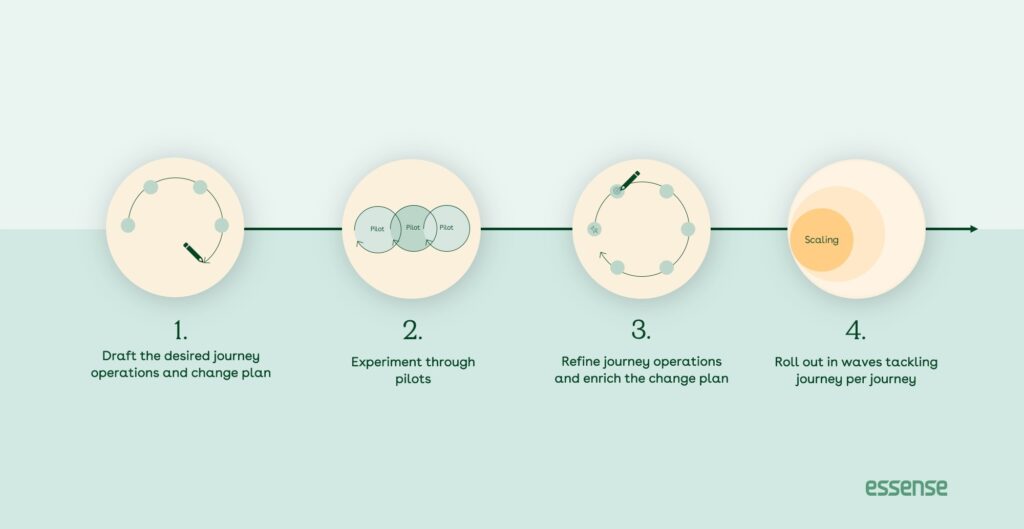
Here’s how organisations can move from fragmented pilots to a mature, governance-led program:
1. draft the desired journey operations and change plan
Start with a draft operational model of how journeys could be managed effectively in your organisation. This is not about perfection — it’s about creating a testable structure. Focus on:
- A journey framework aligned with key departments.
- Governance and way of working draft, or to put it simple: who should do what and when to manage journeys properly.
- Make a change plan with OKR’s to make progress tangible going forward.
Organisations often try to finalise every detail upfront. But journey management is iterative — success starts with a workable first draft. Over-engineering early on slows progress and delays learning.
2. experiment through pilots
Pick a small number of journeys to test the initial setup. Focus on:
- Validating governance: rituals, roles and responsibilities.
- Capturing learnings about the way of working.
- Getting the first internal ambassadors, learn what is needed for wider adoption.
Creating a first success case to reinforce momentum.
Pilots are where theory meets reality — and where the value of structured journey management starts to show.
3. refine the journey operations and enrich the change plan
Use insights from the pilots to improve and expand:
- Update the journey management operations model from step 1 based on learnings.
- Create training and coaching models for wider roll-out.
- Build a roadmap for broader implementation.
This step enables going from pilots into a scalable approach.
4. roll out in waves
Expand implementation in phases across the organisation:
- Formalise roles, like journey managers.
- Apply the way of working to more journeys.
- Train teams to internalise the way of working and governance.
- Keep sharing success cases & business results.
Wave by wave, you move from experimentation to embedding — until the entire organisation works in a journey-centric way.
closing thought
Scaling journey management isn’t just about mapping a bunch of journeys — it’s a shift in how your organisation decides which innovations and improvements to implement. It requires clear governance, and a consistent way of working across teams.
Want to explore how this could work for your team? Let’s talk about where to begin.