

Many companies rely on fresh research for every CX decision. This makes improvements slower and more expensive, decreasing the business impact.
But what if we didn’t need to go back to our real customers every single time? What if we could simulate them—realistically, reliably—and test our ideas instantly?
Welcome to the future of CX improvement: the Customer Digital Twin. This will offer great value – if used wisely.
what is a customer digital twin?
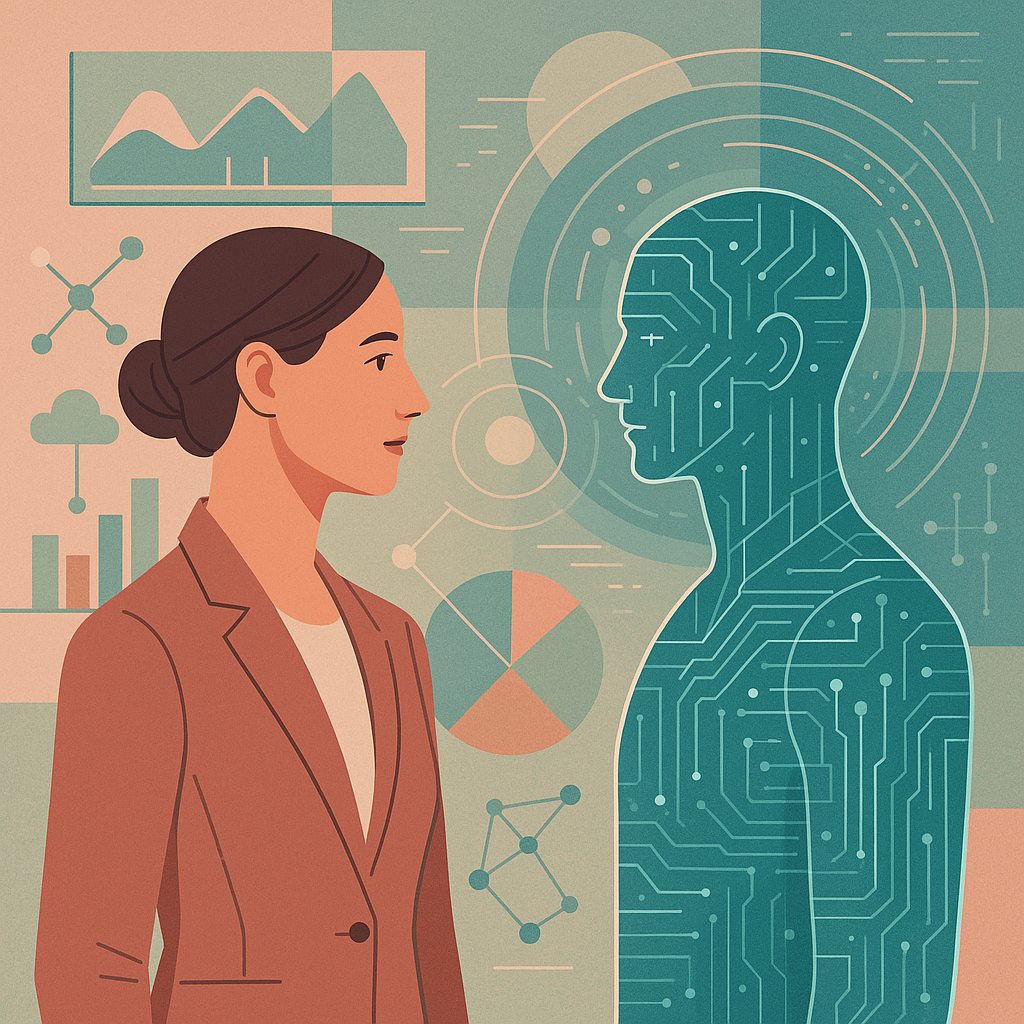
A customer digital twin is a dynamic, data-driven simulation of a real customer—or customer needs segment. Think of it as a living model that can interact with your CX prototypes, react to friction in journeys, and provide feedback based on actual motivations and behaviours in contexts you’ve already uncovered through research.
This isn’t science fiction. It’s a powerful way to bring together the insights you’ve already gathered—qualitative interviews, behavioural data, survey responses—and use them to train a virtual “customer” that can be tested against. Unlike static personas or dashboards that sit unused in a folder, digital twins are alive, interactive, and continuously learning.
why digital twins matter for CX
Let’s face it: most organisations sit on mountains of underused customer insights. Once the research report is filed, the value often fades. But with a digital twin, those insights don’t just sit in a PDF—they power a responsive system that can:
- Test a new journey or prototype – before launch
- Predict emotional reactions - to changes in your service
- Explore what-if scenarios - for different customer segments
- Identify friction points - without conducting another round of interviews
It’s like having a panel of customer experts on standby, 24/7.
the danger of fake twins
Here’s the catch: not all digital twins are created equal. With today’s generative AI tools, it’s dangerously easy to spin up a simulation that looks and sounds like a real customer—without actually being based on anything true.
Type two lines into a prompt—“Act like a frustrated telecom customer in your 50s”—and voilà, your AI says all the right things. But that feedback? It’s hallucinated. It’s fiction. And if you trust it, you’re making decisions based on smoke and mirrors.
A bad twin is worse than no twin. It creates false confidence and misleading insights.
how to build a reliable digital twin
So how do you build a reliable one?
It starts with a clear purpose. What decisions, emotions, or actions are you trying to simulate? Is your twin meant to evaluate a checkout flow? Or test how a loyal customer would respond to a pricing change?
From there, you need to feed your twin with real data:
- Qualitative insights – from interviews, focus groups, and customer stories
- Quantitative data – like behaviour logs, NPS verbatims, and churn predictors
- Contextual relevance – customer segment, brand promise, competitive landscape
This becomes your twin’s DNA. And like any living thing, it should evolve. As you run new studies, gather new data, or learn from real-world experiments, your twin becomes smarter, more realistic, and more useful.
Finally, you’ll need to design the underlying model in a way that allows for careful extrapolation—grounded in real data, based on context—without falling into the trap of hallucination. We’ll dive deeper into how to do that in an upcoming blogpost.

it’s not a bot. it’s a smart research library
The best way to think about your digital twin? It’s not a chatbot or an avatar. It’s a hyper-smart research library—a system that continuously learns from your research and makes those insights instantly accessible and actionable.
Instead of flipping through decks or re-reading transcripts, you interact with a model that already knows what your customers value, fear, and expect. It’s the bridge between human-centered research and data-driven decision-making.
the twin is only as smart as the research behind it
Digital twins won’t replace research. They’ll amplify it – making your past insights continuously useful, accessible, and applicable in new contexts.
But only if they’re built with care, purpose, and a foundation of real customer understanding. Otherwise, they’re just convincing actors delivering unreliable scripts.
The future of CX is faster, smarter, and more scalable. But it’s only as good as the insight engine behind it. So start curating your customer knowledge now—because the better your research today, the smarter your twin will be tomorrow.
Curious how a digital twin could work for your organisation? Let’s talk about how to turn your customer research into something that learns, adapts, and scales.
subscribe to our newsletter
Stay ahead with the latest in Customer Experience (CX), get exclusive access to our newest white papers, insightful blogs, and upcoming events – delivered straight to your inbox!