


The gap between customer insights and solutions is where most investment quietly goes to waste.
This may sound familiar… You know your customers are experiencing barriers and issues through out your journeys. Feedback lights up, drop-off happens in your funnel, and the same three questions keep hitting the support lines. Everyone in the room agrees: we need to fix this!
So a project kicks off. Wireframes get drawn, new designs are developed and months later, the optimised experience goes live. Everyone believed in it. Then the data doesn’t move. Or worse, calls go up.
This is the hopeful release. The new website or redesigned flow is simply switched on, and everyone hopes for the best.
Spotting a customer problem is the easy part. Understanding it well enough on how to solve it, at the right point in the journey and the right moment for the customer, is where the real work sits. That gap between insight and impact is where solutions quietly fail.
That’s why we’re introducing the insight-to-impact approach which ensures your solutions fix the right problem.
We use insight to impact to close this gap between insight on journey level & channel optimisation.
Because an insight tells you where to look. It doesn’t tell you what to build, or whether it will work. That’s what experimentation is for, and it’s the part most transformation projects skip on the way to a big launch. Insight-to-Impact is how the investment ends up on the thing that actually changes customer behaviour, not just the thing that felt right.
We describe the approach in three steps:
1. Gathering insights
Start by finding out what is happening and why. Combine insights from across the customer journey, such as customer service feedback, qualitative interviews, surveys, funnel data and customer base data. Each source tells part of the story. Together, they show what is going wrong and why.
2. Starting small
Insights tell you the what and why. Experiments tell you the how and where.
Define a few concepts to solve the issue. Change details in different parts of the channel, try different storytelling, or step into the journey at a different moment. Each concept starts as a hypothesis about customer behaviour and is measured on a single metric. It could be a copy change or a different component.
Concepts go live through A/B tests in one or more channels, so you see the impact fast. Starting small keeps the investment low and still tells you two things: whether customers actually want your solution, and whether it delivers the result you’re after.
You might start with very little context, or you might already feel confident in your insights. The approach works either way. Treat every concept as a fishing hook cast into open water. What you catch might surprise you.
3. Scaling the right solutions
Once your hook is in the right spot (the right moment in the journey) and you feel a bite (proof that customers want it and that you’re solving the right issue), you can build on the solution with confidence. By then you have enough evidence to iterate and scale.
Want to see this approach in action?
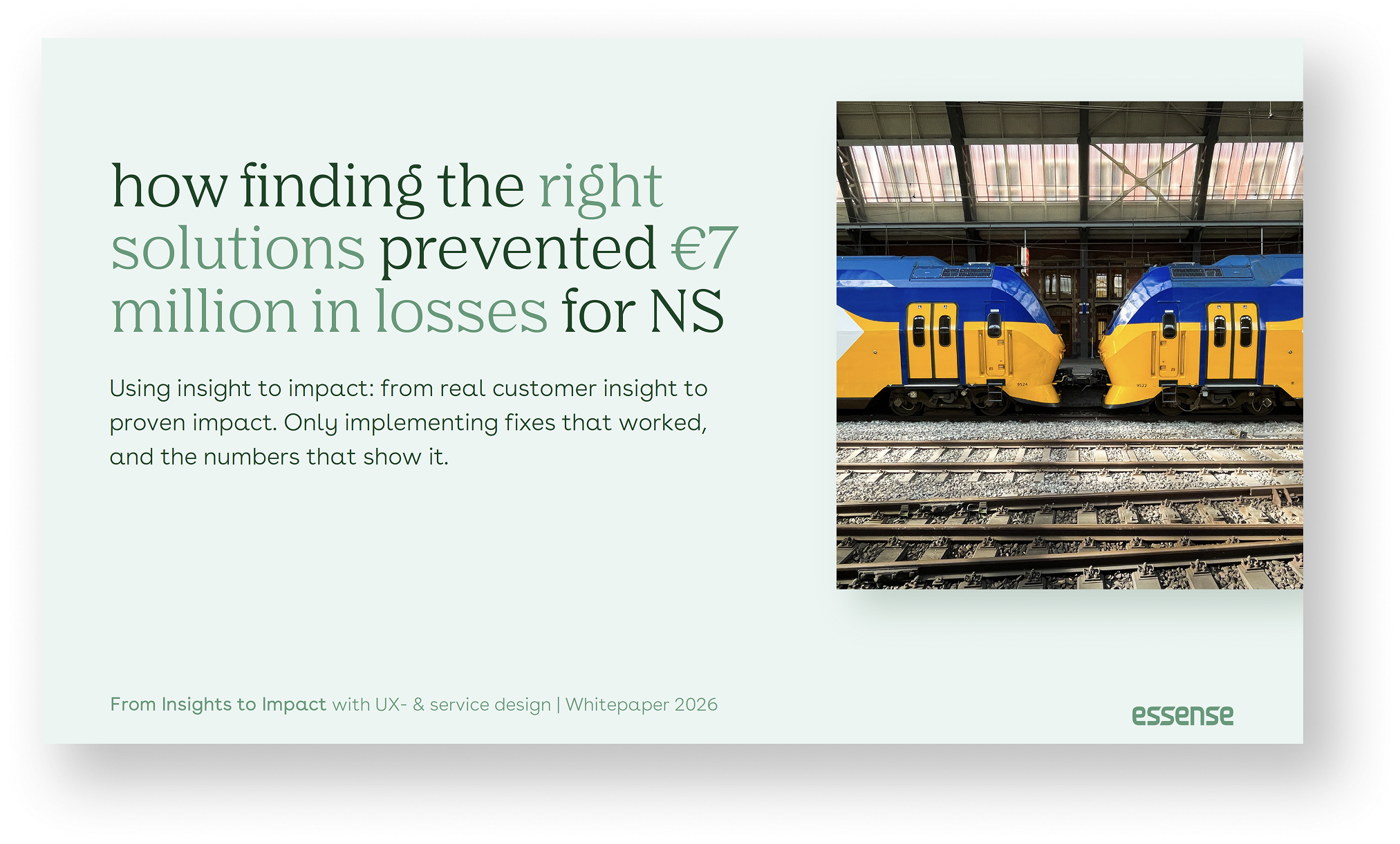
For NS, we applied this approach to their season ticket webshop. Instead of jumping to the obvious fix, we used customer insights and a series of experiments to find out which problem was actually worth solving.
The result: €7 million in prevented losses.
Read how we did it in our whitepaper.