



We often talk about journey mapping as the ultimate tool for customer centricity. But as organisations grow, a collection of separate maps isn’t sustainable to manage anymore. In fact, it can become a liability; a digital drawer full of single journeys that don’t talk to each other.
To mature, you don’t just need more maps; you need a Journey Framework.
Traditionally, these frameworks are seen as an “index” of all your journey maps. At Essense, we see the potential for more! Imagine your upper management board looking at a massive Miro board for the first time. They shouldn’t just see a list of journeys; they should see the operating system of driving customer happiness. A well-designed framework is a “fit-for-function” architecture that aligns your strategy, your data, and your people.
In this article, you’ll learn how a journey framework supports you to move from “mapping journeys” to “managing the customer experience” and what you need to consider to make it work for your specific organisation.
more than an index
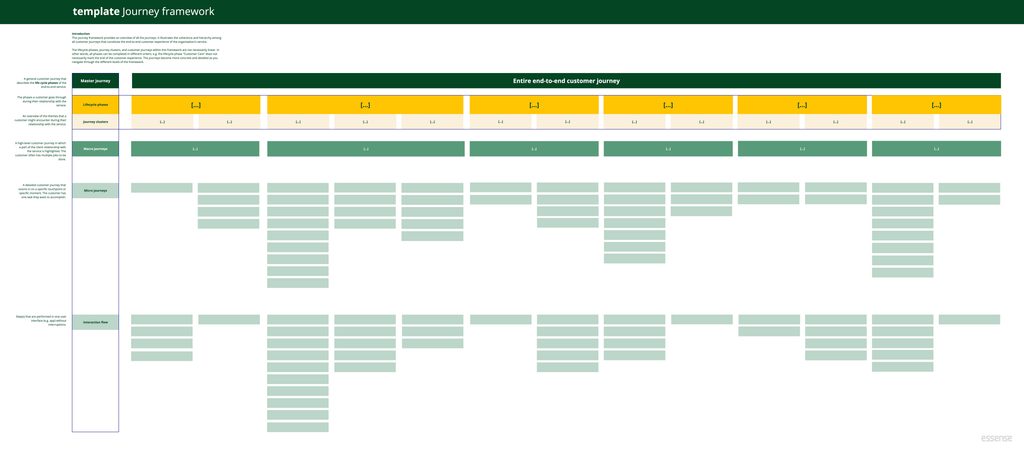
A journey framework is the hierarchical structure that connects your high-level customer lifecycle to the granular interactions happening inside touchpoints.
Think of a journey framework as a collection of topography maps, with different purposes. A world map shows you an overview of all countries that exist. You might use this to decide where to go on holiday. This compares to your master journeys, which captures the overall performance on a lifecycle level. A city map however, might show you what the quickest route is to get to an ice cream shop. This compares to a micro journey, which zooms into specific interactions and flows.
A journey framework works in a similar way. When the CEO talks about overall churn (using the ‘world map’) and a UX designer talks about a friction point in a sign-up flow (using the ‘city map’), the framework ensures they are using a shared language.
the power of purpose: why even build one?
A framework should never be built for the sake of having an index. It must be fit-for-function. Depending on your leadership goals, it usually serves one of three strategic purposes.
A foundation for measurement
It’s hard to prioritise if you can’t compare apples to apples. A framework allows you to map your KPI’s to specific journey stages. This enables a unified CX report that cuts across silos, showing exactly which part of the customer lifecycle is driving (or draining) revenue.
A silo-buster
A framework makes it immediately visible who is working on what. Instead of a Product Manager in “Onboarding” and a Service Designer in “Retention” reinventing the wheel, they can share insights tagged to the same journey steps.
Governance and ownership
It clarifies who “owns” the customer at the hand-over points between departments. It ensures the customer doesn’t feel the internal friction of your organisational chart.
design your own reality
Not every organization needs the same structure. The design of your framework should be a direct reflection of your business model & CX strategy.
For example, if you serve both B2B and B2C segments, a single one-size-fits-all framework will become too big and complex to properly steer on. You likely need distinct frameworks that share a core skeleton so you can still report on total business health while respecting different customer decision-making processes.
The goal isn’t to be chronological; it’s to be logical. The more complex your proposition, the more levels your framework requires. Customers don’t just follow one straight line; they take various paths across the ecosystem. A robust framework should allow for a “zoom” functionality:
Report Upwards: See how detailed, small-step journeys add up to impact the overall lifecycle health.
Deep-dive Downwards: Look at a high-level lifecycle stage and immediately identify which specific sub-journeys are driving the friction.
the future? AI and a ‘living skeleton’
The next step is already here. We are moving toward automated orchestration. With AI-driven tools (like TheyDo), frameworks are no longer static documents; they are “living skeletons.”
Imagine AI automatically tagging thousands of customer feedback entries to the correct spot in your framework in real-time. We can then use the framework as a structural guide to route multiple data sources, ensuring that technical data and customer-centric design finally speak the same language.
how to move forward?
A framework is never truly finished. However, building one without a strategic goal is just busy work. Whether your goal is to align your data, break down silos, or clarify ownership, your framework must be built fit-for-function. It is the infrastructure that allows your organisation to move from mapping journeys to managing your customer experience.
Ready to move beyond the index?
At Essense, we specialise in building journey frameworks that are tailored to your specific organisational goals and complexity. We can help you design a structure that doesn’t just look good on paper, but actually drives your CX results and empowers your teams to collaborate effectively.
Let’s build the backbone of your CX strategy together. Reach out to us to start the conversation!