




For years, one of the biggest constraints in technology and product development has been the build itself. Good ideas got stuck in backlogs. Organisations hired armies of developers. Features took months. Integrations were painful. The bottleneck was almost always: do we have capacity to build this?
That bottleneck is disappearing fast.
AI-powered development is making it possible to build applications, interfaces, and automated experiences at a pace and scale that would have been unimaginable five years ago. What used to take a team of ten and six months now takes a small team and a few weeks. In some cases, days. A dream is coming true. We can build almost anything.
And that’s exactly what makes the next question so urgent.
the fight for attention isn’t getting easier
Here’s the thing: while our ability to build has exploded, people’s days haven’t gotten longer. Customers aren’t getting more patient, more loyal, or more willing to engage with things that don’t matter to them. If anything, the bar for getting the customer’s attention keeps rising.
If every company can now build a personalised onboarding flow, a smart chatbot, an AI-powered recommendation engine, then having one is no longer a differentiator. It’s hygiene.
What will separate the winners from the noise isn’t the ability to build. It’s the clarity about what to build and why it will win the heart of a customer.
knowing what customers want is the new goldmine
This is where CX expertise becomes more valuable, not less.
In a world where building becomes easier , the hard work shifts to defining. What experience will genuinely make a customer feel seen? What does your brand promise, and are you actually delivering on it across every interaction, every channel, every moment? What friction is costing you loyalty without you realising it?
These are not technology questions. They’re customer questions. And answering them well requires a deep understanding of what people need, what creates trust, and what a good experience actually feels like from the outside in.
The organisations that get this right won’t just use good AI. They’ll have AI that’s pointed at the right things.
Intention will be the differentiator
What we’re starting to see, and what we think is only going to become more pressing, is a split between organisations that are building reactively and those that are building intentionally.
Reactive organisations are asking: what can AI do for us? They’re adding features, automating touchpoints, deploying tools. Moving fast.
Intentional organisations are asking a harder set of questions, and they’re asking them on two distinct levels.
The first is the customer-facing level:
what experience do you want AI to deliver to customers? This is more complex than it sounds. Think about GEO, optimising your presence so customers can find and orient themselves through AI-powered search engines. Or a telco that lets customers walk through their home while a voice assistant maps the ideal WiFi setup in real time. These aren’t just chatbots. They’re fundamentally new ways of delivering on a promise. The question is: which of these fits your brand, your customers, and what you’ve committed to deliver?
The second is the internal level:
how do you manage the experience with AI? Do you track customer happiness at a segment level, or are you ready, technically, organisationally, and legally, to do it at an individual level? Do you have the backbone in place to monitor how well you’re delivering on your brand promise across every touchpoint, or are you still relying on periodic surveys and gut feel? AI can now analyse your actual interactions and produce a real-time health score per touchpoint. Imagine being able to optimise every interaction so it’s just right for your brand.
These two dimensions are independent and depend on who you are as a brand. it’s genuinely strategic. You could have highly autonomous CX management behind the scenes, with AI running the whole operation, while still having humans deliver every customer-facing interaction. Or the reverse. The image below captures that space.
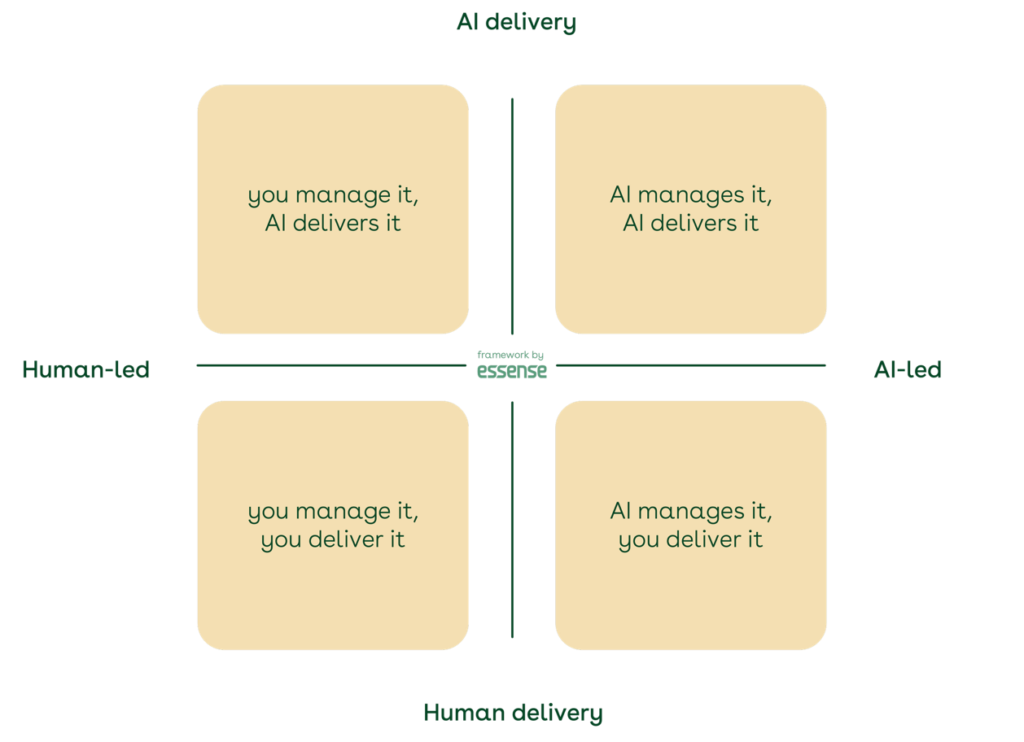
Where you sit in that matrix isn’t right or wrong. But it should be a strategic choice, ot something that happens to you.
a good time to get ahead of it
The good news is that this is still early. Most organisations are still in the phase of figuring out what AI can do. The space to define what it should do, in service of real customer value, is wide open.
At Essense, we’re right in the middle of developing new frameworks and tools to help organisations build a strategy around CX with AI, across both dimensions. If you want to test our early frameworks against your own organisational challenges to see what’s in it for your customers, I’d genuinely love to hear from you. Reach out directly or drop me a message. The more perspectives we can include at this stage, the sharper the thinking will be.
The companies that ask these questions now, before the urgency hits, will be the ones best positioned when every competitor is scrambling to catch up.
👉 Want to be part of the conversation? schedule a call